The Cyber Exchange.
An AI-assisted cybersecurity services marketplace supporting the engagement lifecycle—from defining requirements and preparing proposals to provider selection, contracting, and project completion.
Turning complex requirements
into working software.
Cybersecurity engagements often begin with incomplete requirements, unclear proposals, and poorly defined expectations. The Cyber Exchange was conceived by a cybersecurity professional to help requesters and providers communicate more effectively.
Working closely with the founder, I designed and developed the application's custom functionality—translating evolving business requirements into interconnected workflows, interfaces, and business rules through an iterative design-and-review process.
Built as a business application,
not a brochure website.
WordPress provides the application foundation, extended through custom WordPress plugins and purpose-built PHP, JavaScript, and MySQL components. As requirements exceeded what existing plugins could support, I developed custom workflows, data relationships, role-based permissions, document management, and interactive interfaces. AJAX and REST APIs connect application logic with context-aware AI services.
From initial requirements
to an agreed statement of work.
The core application connects requester and provider workflows. AI supports drafting, clarification, and analysis; people review, approve, and make the decisions. Every screenshot below is from the actual demonstration application. Click to enlarge.
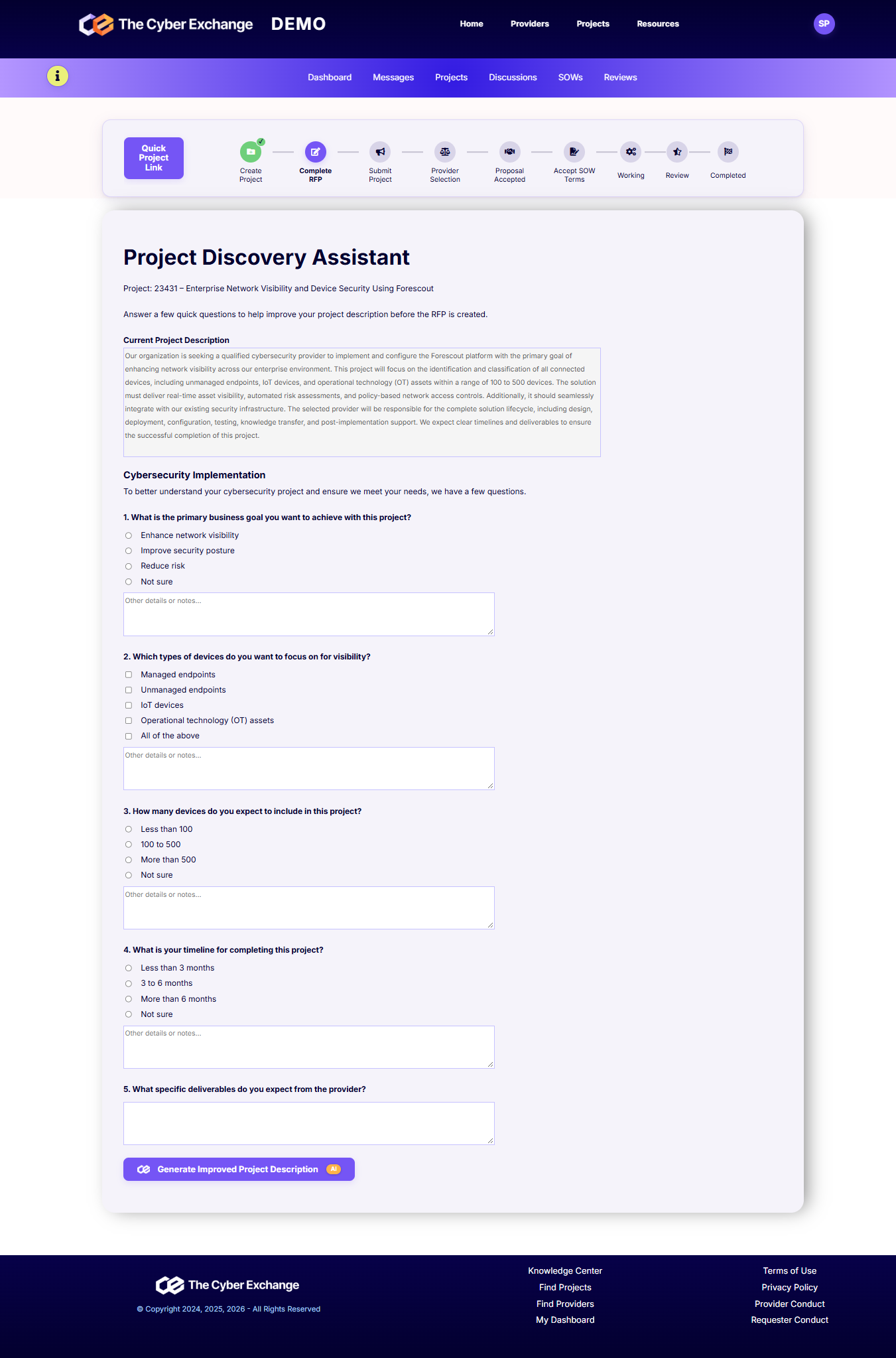
Ask better questions before writing the RFP.
The Project Discovery Assistant analyzes an initial project description and generates tailored questions to identify missing information. Requesters review the improved description before saving it as the foundation for RFP development.
Engineering focus: AI-guided requirements gathering, structured inputs, user-controlled updates.
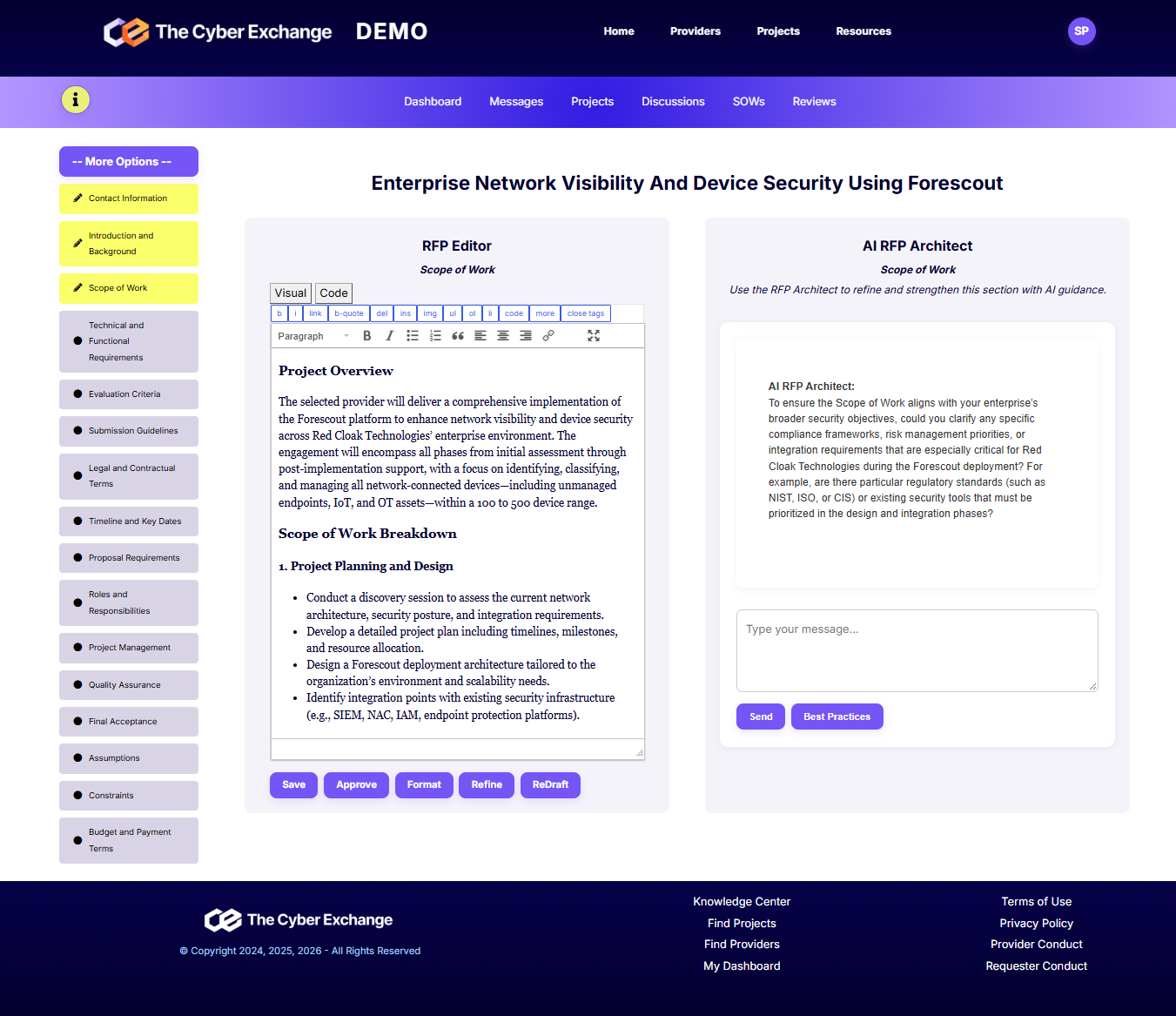
Structured documents with context-aware AI.
The RFP Editor organizes requirements into 16 independently managed sections. An AI RFP Architect uses project details and previously completed sections to help draft and refine content, while the requester controls approval and completion.
Engineering focus: persisted document sections, editing workflows, status tracking, and contextual AI.
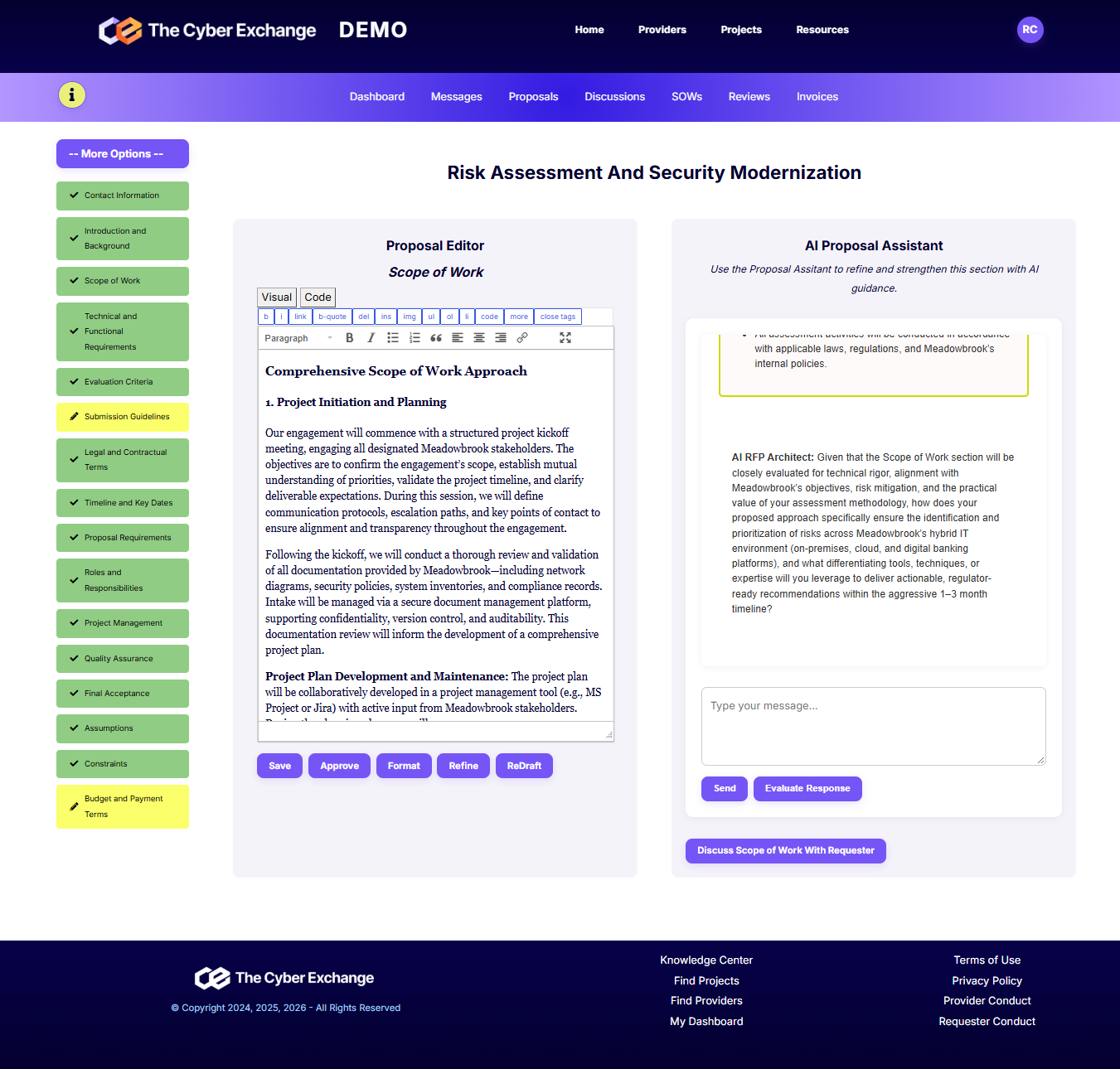
A connected response on the other side.
Providers respond to the requester’s RFP section by section. Their workspace combines rich-text editing, AI-assisted drafting and evaluation, private discussions, cost estimation, and Gantt scheduling.
Engineering focus: role-specific interfaces, linked business records, collaboration, and planning tools.
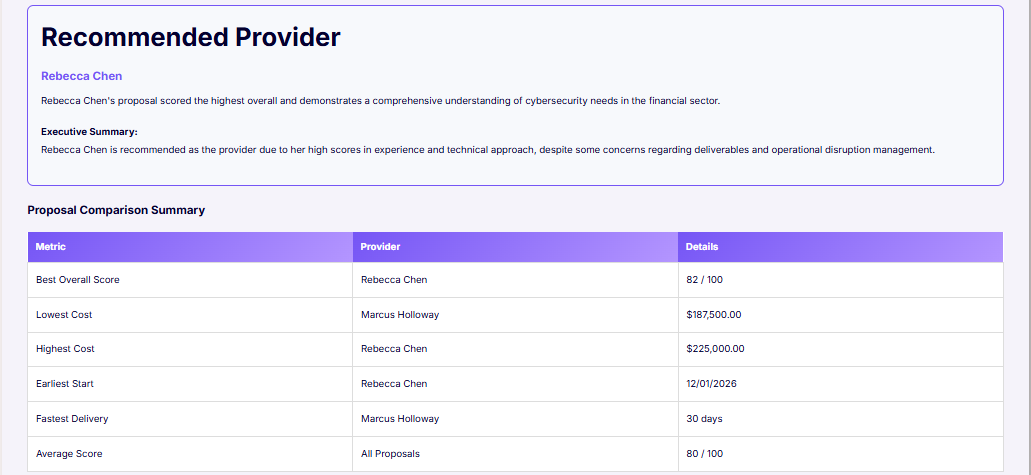
Consistent scoring. Explainable recommendations.
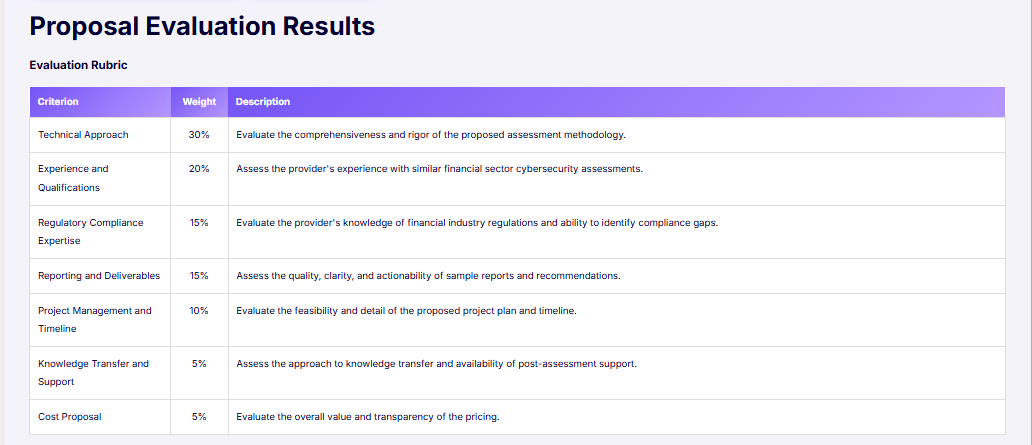
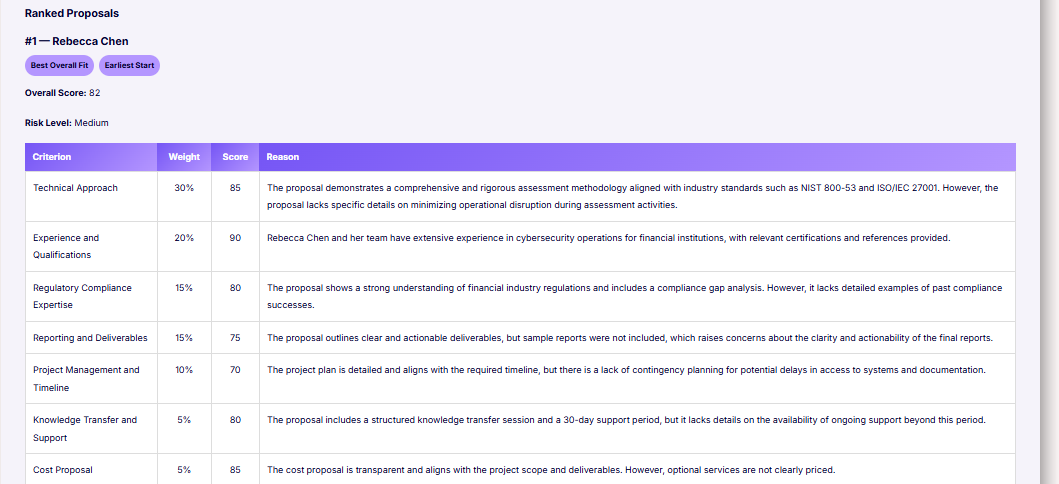
The AI Proposal Evaluation Assistant derives a project-specific weighted rubric from the RFP. Requesters adjust the weights before evaluating competing proposals against consistent criteria.
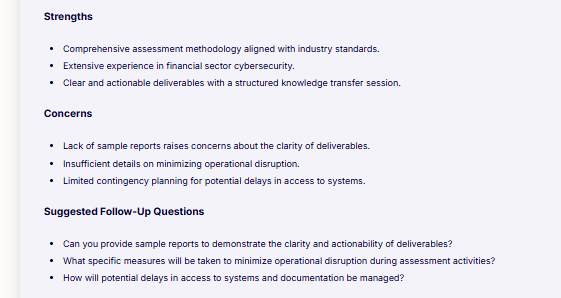
Results include rankings, criterion-level explanations, strengths, concerns, and follow-up questions. Final provider selection remains with the requester.
Engineering focus: configurable scoring, validation, comparative analysis, and human-controlled decisions.
Turn an accepted proposal into an agreed engagement.
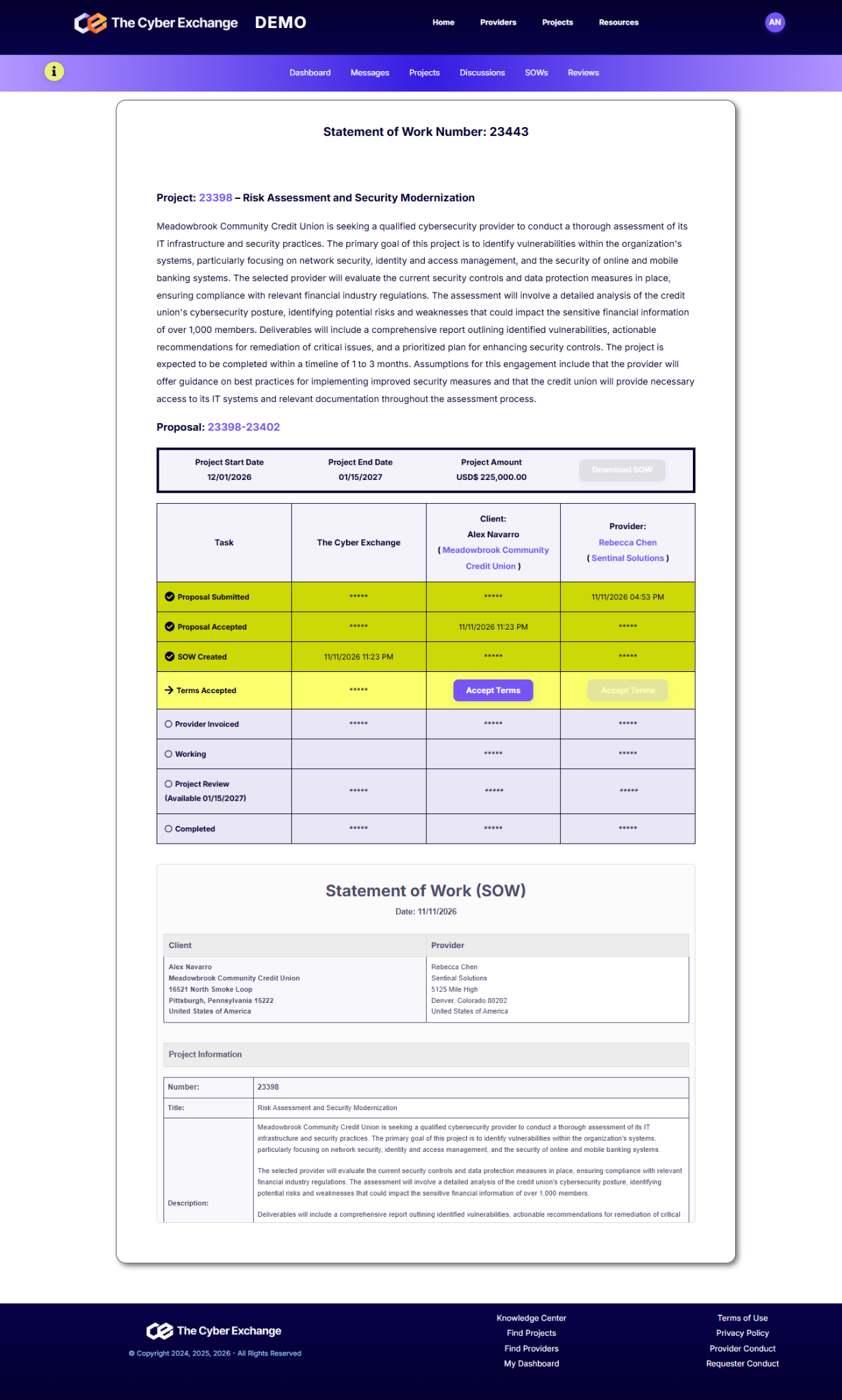
After proposal acceptance, the application assembles a Statement of Work from project requirements, commitments, dates, and pricing. The requester and provider independently accept terms, while an event tracker records milestones and controls when the final PDF is available.
Engineering focus: multi-party approvals, state-dependent actions, event tracking, and document generation.
A complete business application,
not just a document workflow.
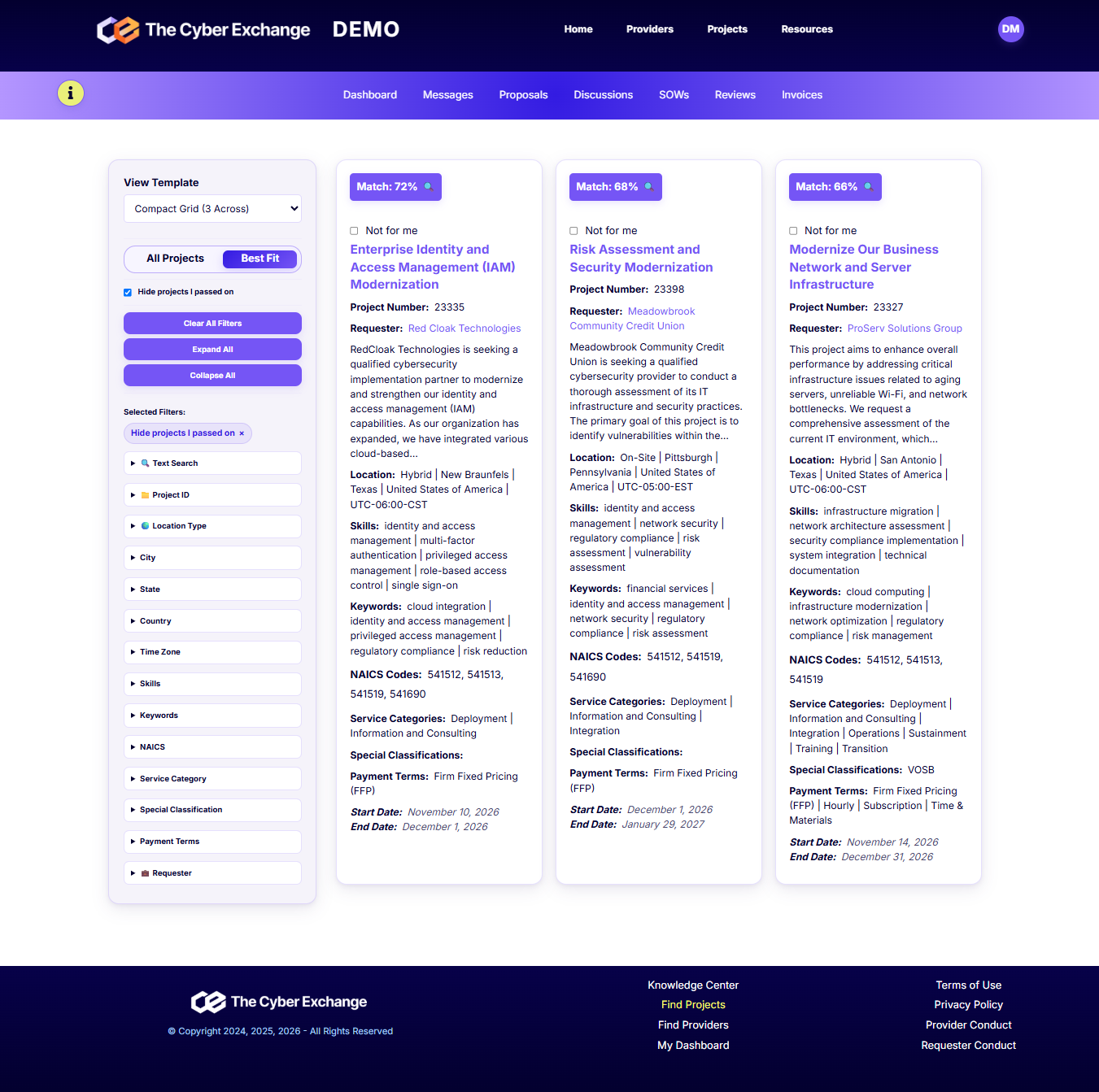
Find the right projects and providers.
Complementary Project Search and Provider Search systems support multi-criteria filtering across skills, certifications, industries, location, NAICS codes, and other classifications. Providers can prioritize opportunities using profile-based match percentages.
Engineering focus: custom queries, structured classifications, personalized matching, and interactive filtering.
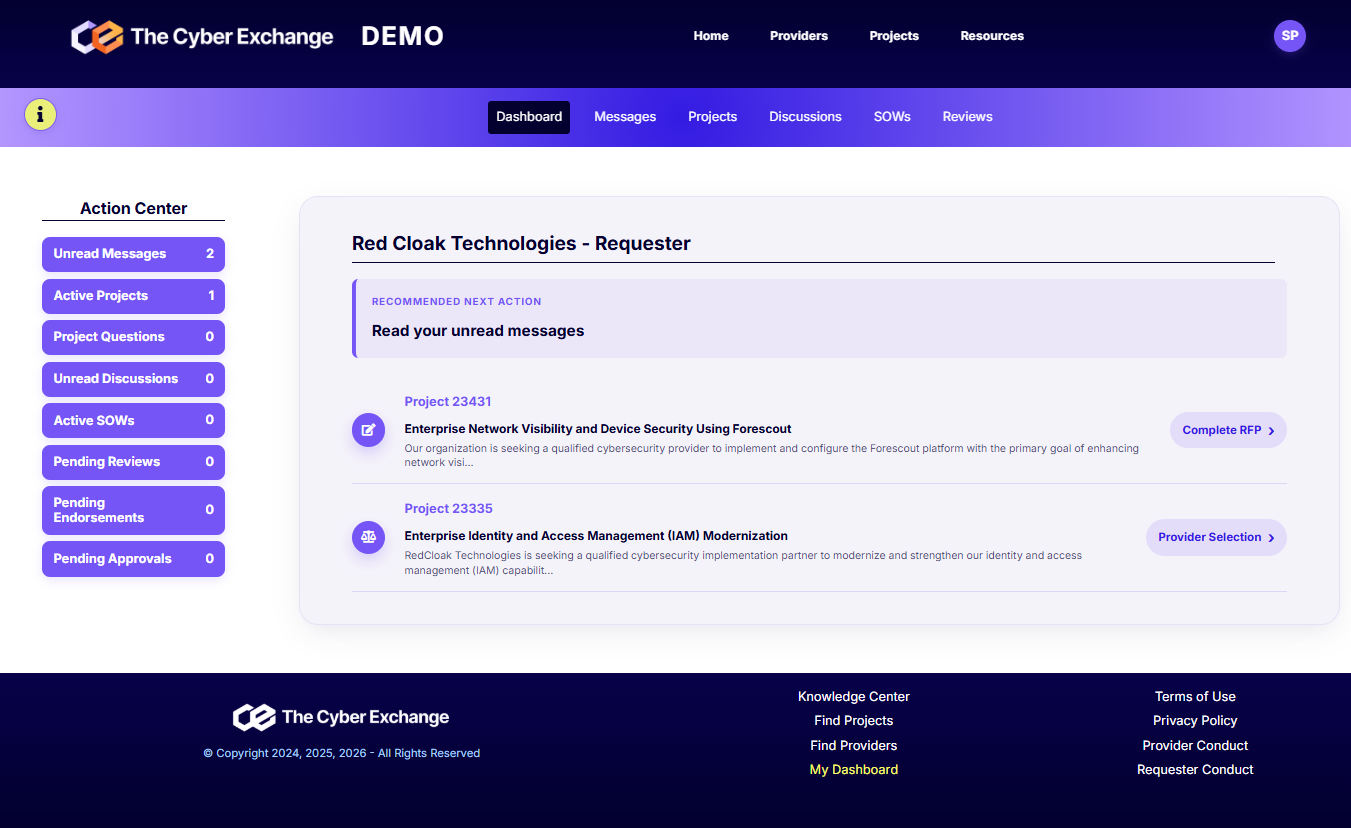
Keep the next action in view.
Separate requester and provider dashboards act as operational hubs for projects, proposals, messages, approvals, and outstanding work. They recommend next actions and expose controls appropriate to the current workflow stage.
Detailed profiles, notifications, invoicing, reviews, and an integrated context-sensitive help system support the broader application experience.
Engineering focus: role-aware dashboards, activity aggregation, workflow-driven controls, and in-context documentation.
Connecting the pieces
into a working application.
The Cyber Exchange demonstrates my ability to translate complex business requirements into functioning software—combining architecture, custom development, workflow design, data management, and practical AI integration. The approach is the same one I bring to business software generally: understand the problem, collaborate with stakeholders, build practical solutions, and adapt as requirements evolve.